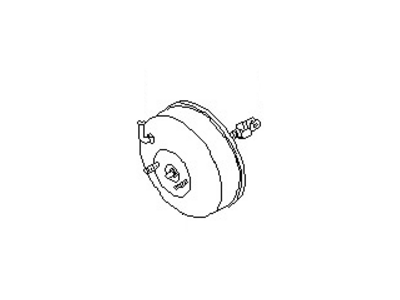
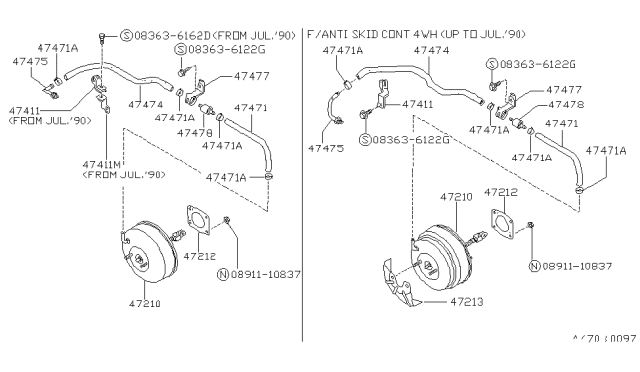
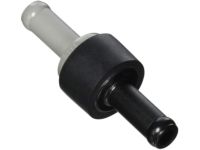
Power brakes can be deemed to work in the same way as non-power brake systems but with the difference arising from the way master cylinder piston is actuated with assistance from vacuum diaphragm situated at the front of the master cylinder. This diaphragm helps the driver apply the brakes; it lessens the amount of force and space through which the brake pedal has to travel. The vacuum diaphragm housing is attached to the intake manifold and is connected with the help of a vacuum hose having a check valve when ever there is low manifold vacuum and thus the brake assist vacuum is not lost. When the brake pedal is pressed, the vacuum is cut-off, thus allowing pressure from the atmosphere to be applied to one side of the diaphragm and this in-turn pushes the master cylinder pistons out and applies the brakes. The release of the brake pedal returns the vacuum on both sides of the diaphragm, and return springs take the diaphragm with the master cylinder pistons to their initial position. When the vacuum does not build up, the connection between the brake pedal rod and the end of the master cylinder actuating rod comes into play and the vehicle's brake is applied mechanically as one presses the brake pedal. The dysfunctions regarding the hydraulic and mechanical mechanisms valid for ordinary brake systems also apply to power brakes and one can examine them as causes if the problems are recurrent. To check for a system vacuum leak rev the engine up to idle and do not step on the brake pedal for one minute or more and shuts down the engine and waits for one more minute. Closely inspect assist vacuum by step on and off the brake pedal several time, the light pressure will decrease the pedal travel if assist vacuum is there. When no vacuum is registered, the inference is that air is probably entering the system. For systematic operating test-turn off the engine and pump the brake with the supply vacuum until the light exhaustion after this apply steady pressure to the brake pedal. Situation of turning on the vehicle engine together with building up pressure should make the brake pedal depress downwards if the above system is properly functioning. Besides, power brake systems may also be checked for hydraulic leaks as the ordinary brake systems may be.