×
- Hello
- Login or Register
- Quick Links
- Live Chat
- Track Order
- Parts Availability
- RMA
- Help Center
- Contact Us
- Shop for
- Nissan Parts
- Nissan Accessories

My Garage
My Account
Cart
Genuine 2013 Nissan Juke Cylinder Head
Head- Select Vehicle by Model
- Select Vehicle by VIN
Select Vehicle by Model
orMake
Model
Year
Select Vehicle by VIN
For the most accurate results, select vehicle by your VIN (Vehicle Identification Number).
1 Cylinder Head found
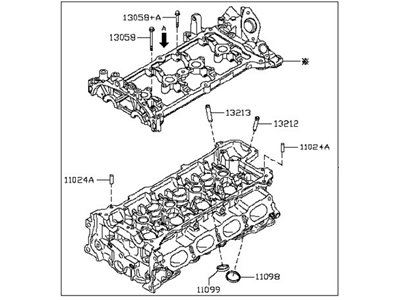
2013 Nissan Juke Cylinder Head
Part Number: 11040-1KC1B$1718.77 MSRP: $2079.99You Save: $361.22 (18%)Ships in 1-2 Business DaysProduct Specifications- Other Name: Head Assembly - Cylinder
- Replaces: 11040-1KC0B
- Lookup Code: 11041
- Item Weight: 38.80 Pounds
- Item Dimensions: 22.1 x 13.0 x 10.2 inches
- Condition: New
- Fitment Type: Direct Replacement
- SKU: 11040-1KC1B
- Warranty: This genuine part is guaranteed by Nissan's factory warranty.
2013 Nissan Juke Cylinder Head
Committed to delivering top-notch quality at affordable prices, our website is your go-to source for OEM 2013 Nissan Juke Cylinder Head worldwide. Each of our genuine 2013 Nissan Juke Cylinder Head come with a manufacturer's warranty, so rest assured, quality and cost are covered. With us, you're making a smart choice that stands the test of time.
2013 Nissan Juke Cylinder Head Parts Questions & Experts Answers
- Q:How to remove and refit the engine components, including the cylinder head on diesel 2013 Nissan Juke?Posted by Amy E.A:As an initial step concerning the removal of the engine, you will have to drop the oil pan by draining the engine oil with a new sealing washer and expect the torque to be tightened as recommended. If we are near the next service interval of an engine, then it is recommended to change the oil filter as well. Once assembly is completed, put in new fresh oil into the engine. Subsequently, take off the cylinder head cover, fuel injectors, fuel rail, high pressure fuel pump, exhaust manifold, timing belt, camshaft and the followers, and the tensioner roller for the timing belt. Remove the inner timing cover by unbolting and then removing it with the use of three/8-inch extension, then remove all the bolts which hold the cylinder head with a ¾-inch extension while removing them in a sequence from bottom up then the cylinder head can be lifted off the block using a hammer and wooden block. It is recommended to take out the gasket and indicate the locating dowels. For refitting, the surfaces that include the area where the cylinder head and block come together should be free from gasket and carbon deposits by using a scraper, and clean the piston tops. It is worth seeing if there has been any form of damages on the block and head; if warpage is assumed, use the straight-edge to confirm. Machining and access to clean the cylinder head bolt holes must be done and the oil cleared to avoid hydraulic pressures. Torque the cylinder head bolts using a new set while omitting oil on the threads. For refitting the mating surfaces should be cleaned, dowels checked, a new gasket should be inserted and the cylinder head assembly properly aligned and fitted. Place washers on the new head bolts, tightened them up to some time and then tighten to the next greater tightening sequence in line with the set torque. Finally, put back the inner timing cover, timing belt tensioner roller, the two camshafts, the timing belt, the exhaust manifold, HPFP, fuel rail, the four fuel injectors and lastly re-fix the cylinder head cover.Answered by Nissan Parts Specialist Jim / Mar 19, 2025
Related 2013 Nissan Juke Parts
 2013 Nissan Juke Cylinder Head Bolts
 2013 Nissan Juke Cylinder Head Gasket
 2013 Nissan Juke Timing Cover
 2013 Nissan Juke Camshaft
 2013 Nissan Juke Spool Valve
 2013 Nissan Juke Intake Valve
 2013 Nissan Juke Exhaust Valve