×
- Hello
- Login or Register
- Quick Links
- Live Chat
- Track Order
- Parts Availability
- RMA
- Help Center
- Contact Us
- Shop for
- Nissan Parts
- Nissan Accessories

My Garage
My Account
Cart
Genuine Nissan 350Z CV Boot
Axle Boot- Select Vehicle by Model
- Select Vehicle by VIN
Select Vehicle by Model
orMake
Model
Year
Select Vehicle by VIN
For the most accurate results, select vehicle by your VIN (Vehicle Identification Number).
2 CV Boots found
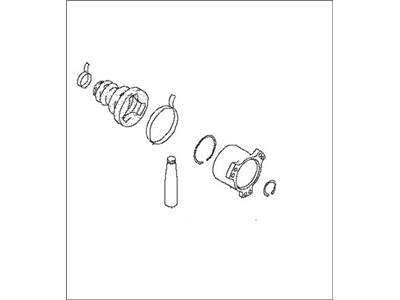
Nissan 350Z Dust Boot Rear Drive Shaft Repair Kit
Part Number: 39741-03P88$56.67 MSRP: $78.12You Save: $21.45 (28%)Ships in 1-3 Business Days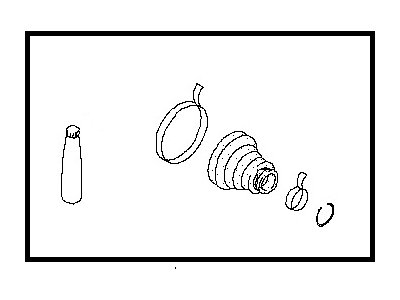
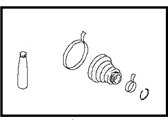
Nissan 350Z Dust Boot Outer Repair Kit
Part Number: 39241-73L28$146.73 MSRP: $207.25You Save: $60.52 (30%)Ships in 1-3 Business Days
Nissan 350Z CV Boot
The Nissan 350Z CV Boot is placed over a driveline constant velocity joint to hold in grease and keep contaminants out. It is located at the end of the axle shaft over the joint on either end. The CV Boot flexes along with the wheels turning and suspension moving, allowing power to be passed through and sealing in the special grease required for constant velocity. CV Boots are rubber or plastic protective coverings that shield a vehicle's CV joint from dirt. The boot's joint prevents any contaminants from entering and keeps the inner workings of the joint safe. If the CV Boot isn't secured, lubricant would leak out and dirt could penetrate the joint, increasing wear and risking failure. A normal driving routine of the Nissan 350Z requires regular inspections of the CV Boot for continued driveline protection. Each Nissan 350Z needs this simple CV Boot to ensure consistent power transfer during steering and the suspension's movement. The design is simple in nature and specified by Nissan for the sort of uses it will get on the 350Z.
If you need any OEM Nissan 350Z CV Boot, feel free to choose them out of our huge selection of genuine Nissan 350Z CV Boot. All our parts are offered at unbeatable prices and are supported by the manufacturer's warranty. In addition, we offer quick shipping to have your parts delivered to your door step in a matter of days.
Nissan 350Z CV Boot Parts Questions & Experts Answers
- Q:How to Check CV Boot and Shock Absorber on Nissan 350Z?Posted by Panagiotis K.A:Keep checking the steering linkage and other parts of the suspension. Worn or defective suspension and steering linkage components can lead to excessive and irregular tire wear, poor ride quality, reduced vehicle handling as well as fuel economy. To check the shock absorbers: Park your car on level ground, switch off the engine and set the parking brake. Push down at one corner of the vehicle and release it, noting what happens to the body next. Any upward or downward movement of the vehicle even after releasing it indicates that a weak or worn-out shock absorber is responsible for this state of affairs. If there is any bounce in a vehicle when depressed at one corner, this indicates a worn-out or weak shock absorber. Repeat this procedure for each remaining corner of the car. Lift up your car and support it with jackstands securely to inspect shocks for fluid leakage or other damage while assuring they are not only securely fastened but also are leak-free. Visually examine components such as seals, boots, bushings and leaks for damage and distortion. Check out where control arms meet chassis for bushings; these should be intact without any signs of corrosion. Clean the lower end of the steering knuckle while an assistant wiggles wheel in and out looking for play at the steering knuckle-to-control arm ball joint if there is any replace suspension ball joint(s). Grasp each front tire while pushing in towards front then pull outwards towards rear to determine if there is play in any parts constituting steering system; if you note any freeplay-check idler arm as well as tie-rod ends for looseness. Lastly, remember to assess CV boots which prevent dirt water etc from ruining CV-joints by tearing cracking losing clamps; replace them when cracks are noticed or lubricants leak.Answered by Nissan Parts Specialist Javi / Feb 14, 2023