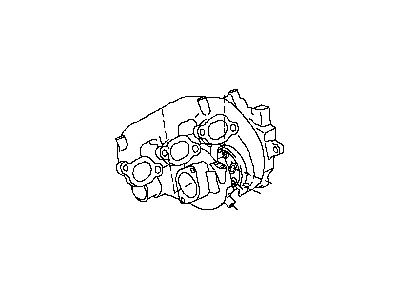
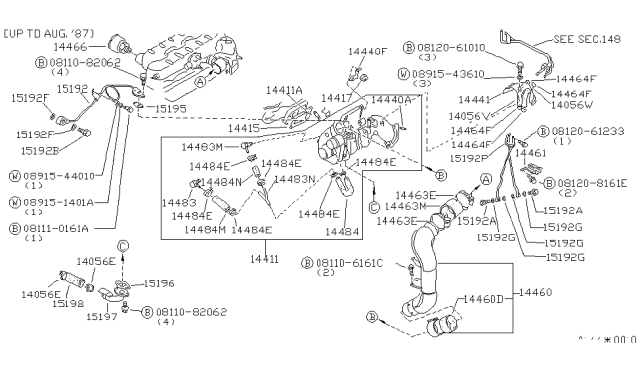
If any of the internal components, such as the waste gate, bearing(s) or oil seals are defective it will be necessary to replace the turbocharger as an assembly. New and factory rebuilt turbochargers are available from your Nissan dealer or local parts store. If the engine is lacking power, check for air leaks around the compressor, inlet/outlet tubes or the intake manifold and correct any faulty connection. If the engine shows excessively high engine power check for a disconnected or cracked rubber hose on the bypass valve. Replace the hose if a defect is found. If the engine exhibits excessively high oil consumption or the exhaust shows pale blue smoke, check for oil leaks at the lubricating oil passage connection. Further checks will require removal of the turbocharger. Remove the turbocharger. With the turbocharger on the work bench, inspect the turbine and compressor wheel by visually checking for cracks, clogging, deformity or other damage. Spin the wheels and check for free movement and abnormal noise or friction. Check axial play using a dial indicator positioned through the inlet opening on the compressor shaft. Using hand pressure only, move the compressor fan as far away 4 from the dial indicator as possible and zero the indicator. Push the compressor wheel toward the dial indicator and compare clearance to the Specifications. If the reading shows too much free play the turbocharger will have to be replaced.